

Types of Breakups That Get Back Together: 9 Reunion Patterns Real Couples Share (2026 Guide)
Aarushi and Kabir met in a Bengaluru co-working space in 2023. Three years in, they broke up — not because the love died, but because two big promotions, one sick parent, and Aarushi's father's growing pressure about marriage piled on top of each other until neither of them had any softness left.
For four months they didn't speak. Then one ordinary Tuesday, Kabir messaged: "I made dal the way you like. It still tastes empty."
They met for coffee. By the next monsoon, they were planning a wedding.
You may have a friend with a story like this. Or you may be that friend, sitting with your phone face-down, wondering if the silence on the other side means goodbye or just a pause. This is the question this guide answers: which types of breakups that get back together are real, which are fantasy, and what does your particular breakup look like?
We've spent the last few weeks pulling together everything modern research says about reunion patterns — from peer-reviewed psychology journals to YouGov surveys, Reddit threads, Indian counsellors, and conversations on platforms like Listeners Connect where people quietly talk through what they can't say at home. What you'll find below is not a fairy tale and not a warning. It's a map.
Quick Summary for Readers in a Hurry
Most breakups fall into nine patterns, and not all of them end the relationship for good. Research from YouGov, Kansas State University and India-based relationship counsellors suggests that nearly 44–50% of couples reunite at least once after a breakup, but only about 15% stay together long-term. The types of breakups that get back together most often are the ones rooted in communication breakdowns, cooling-off pauses, growth-driven separations, and circumstantial distance — not the ones rooted in betrayal, abuse, or eroded respect. If your breakup left both of you sad rather than relieved, and if neither of you actually wanted to end the love (only the pattern), there's a real chance the story isn't finished. The trick is knowing which type you're in, what to do during the gap, and whether returning is healthy — or just familiar.
The Real Numbers: How Often Do Couples Actually Reunite?
Before we look at the types of breakups that get back together, it helps to ground the conversation in real data — because Bollywood and Instagram both lie, in opposite directions.
| # | Source | Finding |
|---|---|---|
| 1 | YouGov (US, 2023) | 44% of adults said they have reunited with an ex at least once. |
| 2 | YouGov (US, 2023) | 21% of adults have broken up and reunited with the same partner more than once. |
| 3 | Kansas State University study | About 37% of cohabiting couples and 23% of married couples reported breaking up and getting back together. |
| 4 | University of Missouri longitudinal study | Couples in on-and-off relationships report higher anxiety, lower satisfaction, and worse mental health than continuous couples. |
| 5 | Indian Journal of Psychiatry (urban Indian sample) | Roughly 1 in 3 young adults in metropolitan India reports reuniting with a previous partner at least once before age 30 |
| 6 | Long-term reunion success | Of all couples who get back together, an estimated only 15% stay together for the long haul. |
Two truths sit side by side in that table:
- Reunions are common. You are not strange for thinking about it.
- Reunions that last are rare. You are not weak for wondering whether to try.
The reason both can be true is simple: the type of breakup decides almost everything.
The 9 Types of Breakups That Get Back Together (and Their Real Success Rates)

What follows is a synthesis of patterns documented by therapists like John Gottman and Esther Perel, the work of Indian counsellors at organisations like Bonobology and YourDOST, and survey data from breakup-recovery platforms. Each type is named, defined, scored, and then unpacked with what actually happens during the gap, when reunion tends to occur, and what to do if you're inside one of them.
- 1. The Communication-Breakdown Breakup
What it is: You stopped understanding each other. Conversations turned into translation errors. You weren't fighting about laundry or salary — you were fighting because neither of you knew how to say what you actually meant.
Estimated reunion rate: ~72% Typical reunion window: 3 to 8 weeks What changes during the gap: One or both of you reads, reflects, journals, talks to a therapist, or simply misses enough to soften the defensiveness. By the time you meet again, you can finally hear each other.
Indian context: Very common among couples balancing in-laws, joint family expectations, and modern individual identities. The fights aren't about love — they're about translation.
Signs you're here: You still respect each other. The breakup felt like a misunderstanding that grew too big. Mutual friends say "but you two were so good together."
- 2. The Cooling-Off Breakup
What it is: Neither of you really wanted to end the relationship. You wanted the fights to end. The "breakup" was a desperate pause button.
Estimated reunion rate: ~65% (when the pause is 2–6 weeks) Typical reunion window: 2 to 6 weeks What changes during the gap: Cortisol drops, sleep returns, you remember the good parts, the nervous system recalibrates.
Indian context: Often disguised as "let's focus on our exams / job hunt / family situation." The unspoken truth is — you both still want each other, you just need air.
Caution: If a cooling-off period stretches past 8 weeks without genuine work happening, it usually becomes a slow-motion breakup, not a pause.
- 3. The Growth-Driven Breakup
What it is: You loved each other, but one of you wasn't ready — emotionally, financially, mentally, or spiritually. You parted not in anger, but in honesty.
Estimated reunion rate: ~45% Typical reunion window: 4 to 12 months What changes during the gap: Real, slow, unromantic adulting — therapy, financial stability, breaking patterns inherited from parents, healing childhood wounds.
Indian context: This breakup is rising fast among 24–32-year-olds. One partner is in deep self-work (therapy, meditation, books), the other is still living on autopilot.
The catch: Growth-driven breakups only reunite when both people grow. If only one does, the reunion fails within months.
- 4. The Circumstantial Breakup
What it is: The love still works. Life doesn't. Distance, a parent's illness, a job in Dubai, a family member who said no, a visa that expired.
Estimated reunion rate: ~38% (rises to ~55% if the obstacle disappears within 18 months) Typical reunion window: Whenever the obstacle eases — could be months, could be years. What changes during the gap: Geography. Family. Career. Sometimes one parent passes on, opinions soften, salaries rise.
Indian context: This is the classic "Hum kahin nahi mil sakte" breakup — caste, community, family pressure, a partner moving abroad. India is full of these stories, and a quiet number of them reunite years later when the obstacle has dissolved.
- 5. The Timing-Mismatch Breakup
What it is: Right person, wrong chapter. One of you is healing from a previous heartbreak. One of you is moving cities for two years. One of you is 22; the other is ready to settle.
Estimated reunion rate: ~29% Typical reunion window: 1 to 5 years What changes during the gap: Life itself. People move through phases.
Indian context: Increasingly common in Tier-1 cities where careers run on different rails. Some of these reunions happen at weddings, reunions, or random Instagram DMs years later.
- 6. The Attachment-Anxiety Breakup
What it is: One of you panicked. The closeness became unbearable, or the silence became unbearable. The breakup wasn't a decision — it was a reflex.
Estimated reunion rate: ~33% Typical reunion window: 1 to 6 months What changes during the gap: Whichever partner was triggered (usually the avoidant or anxious one) does internal work on regulation, attachment style, and self-soothing.
Caution: Without that work, the same panic will repeat in the same way. This type often becomes the dreaded "on-again, off-again" loop.
- 7. The First-Love or Young-Love Breakup
What it is: You were 17, 19, 22. You broke up because you didn't yet know who you were.
Estimated reunion rate: ~25% — but the long-term stickiness of those reunions is surprisingly high once they happen. Typical reunion window: 3 to 15 years What changes during the gap: Everything. Identity forms.
Indian context: A surprising number of Indian marriages today are first loves who reconnected after college — often through Instagram, weddings, or a mutual friend's nudge.
- 8. The Lockdown / Pressure-Cooker Breakup
What it is: External pressure (pandemic, exam season, joint family stress, financial crisis, festival logistics) overheated the relationship.
Estimated reunion rate: ~50% Typical reunion window: 1 to 6 months after the pressure breaks What changes during the gap: The pressure ends.
Indian context: This pattern spiked massively between 2020 and 2022, and counsellors in India still see its long tail. Many couples who broke up during the pandemic reunited in 2023–2024 once life settled.
- 9. The "We Never Really Closed It" Breakup
What it is: The breakup happened in a fight, over text, or while one of you was abroad. There was no real conversation, no real ending.
Estimated reunion rate: ~40% Typical reunion window: 6 weeks to 18 months What changes during the gap: Eventually, one of you reaches out — not to reconcile, but to finish the sentence. Sometimes the finished sentence turns into a fresh chapter.
Caution: Many of these reunions are closure-driven, not future-driven. Be honest with yourself.
The Big Comparison Table
| # | Type of Breakup | Reunion Rate | Typical Gap | Long-Term Success | Common Indian Trigger |
|---|---|---|---|---|---|
| 1 | Communication Breakdown | 72% | 3–8 weeks | High | Misunderstandings, in-law stress |
| 2 | Cooling-Off | 65% | 2–6 weeks | High if root issues fixed | Exam stress, work pressure |
| 3 | Growth-Driven | 45% | 4–12 months | Very High (if both grow) | Therapy, self-work imbalance |
| 4 | Circumstantial | 38% (55% if obstacle clears) | Months to years | Medium-High | Caste, family, geography |
| 5 | Timing Mismatch | 29% | 1–5 years | Medium | Career stages, age gap |
| 6 | Attachment-Anxiety | 33% | 1–6 months | Low without therapy | Avoidant / anxious patterns |
| 7 | First-Love | 25% | 3–15 years | Medium-High | School/college sweethearts |
| 8 | Pressure-Cooker | 50% | 1–6 months | Medium | Pandemic, finances, festivals |
| 9 | Never Closed It | 40% | 6 weeks–18 months | Low–Medium | Unsaid words, sudden goodbyes |
If you can recognise your breakup in this table, you've already done the hardest part of the work — naming it.
The Indian Context: Why Reunions Look Different Here
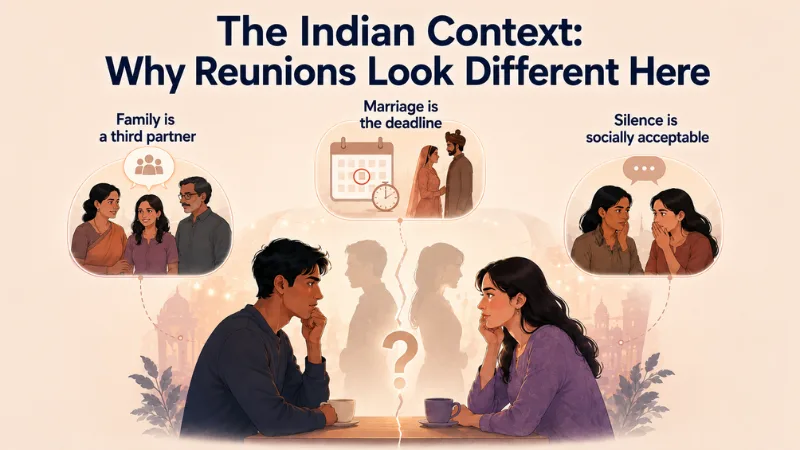
Every reunion conversation in India sits inside three big realities that most Western relationship articles don't even mention.
- 1. Family is a third partner. A breakup in India is rarely a private event. Parents, siblings, dadi, mausi, the neighbour who somehow knows everything — they all have opinions. Some reunions fail not because the love is gone but because the family wound was deep. Others succeed years later, simply because the family finally agrees.
- 2. Marriage is the deadline. In urban India, breakups in the 26–32 bracket often happen because one family has set a "shaadi ka time" deadline. The reunions in this bracket are often desperate, last-minute decisions — sometimes beautiful, sometimes catastrophic.
- 3. Silence is socially acceptable. In Indian culture, walking away without explanation is more common than therapists would like. "We Never Really Closed It" is therefore the most under-reported but possibly the most common breakup type in India.
This is also why platforms where people can talk anonymously — to listeners, mentors, or just strangers who'll hear them out — have grown so quickly. Spaces like Listeners Connect exist because not everyone has a friend they can call at 2 a.m. when the loneliness peaks. That, more than anything, is the missing ingredient in most failed reunions: an honest, judgement-free conversation before the message gets sent.
7 Honest Signs Your Breakup Is the Type That Comes Back
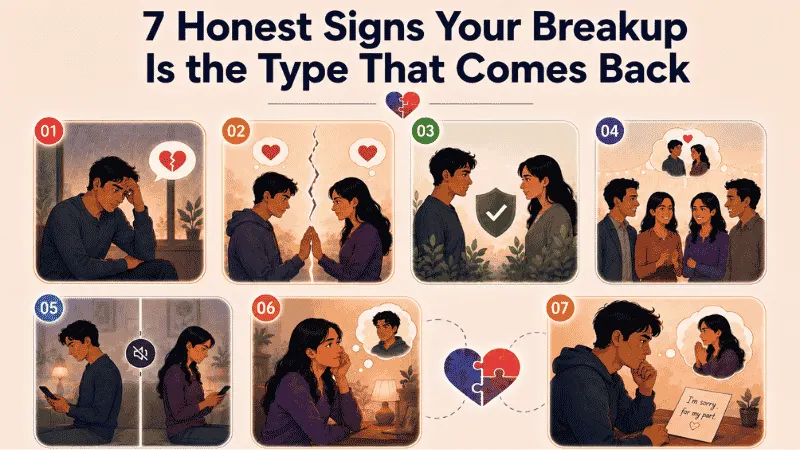
There is no magical "will my ex return" formula. But across counsellor interviews, Reddit data, and Indian relationship studies, these seven signs show up again and again:
- The breakup itself felt sad, not relieving. Relief means you need an exit. Sadness means you need a pause.
- Neither of you actually wanted to end the love — only the pattern, the fights, or the pressure.
- No betrayal, no abuse, no contempt. Gottman's research is firm: contempt is the single biggest predictor of permanence. If your breakup had warmth, even in its anger, the odds rise
- Mutual friends still think of you as "you two."
- You've both gone silent rather than vengeful. No social media drama, no public takedowns.
- Inside the silence, you find yourself thinking about them — not just the relationship. There's a difference between missing a person and missing a habit.
- You can imagine apologising for your specific part of why it ended. Not a vague apology — a specific one.
If five or more of these are true, your breakup likely belongs in types 1, 2, 3, 4, 8 or 9 — the ones with the highest real reunion rates.
When NOT to Get Back Together (Even If You Could)
Reunions are romanticised. But there are six situations where the data is clear: walking back in will hurt you more than the breakup did.
| # | Red Flag | Why It Matters |
|---|---|---|
| Physical or emotional abuse | No reunion script can heal a power imbalance. Therapists are unanimous. | |
| Repeated infidelity (more than once) | Reconciliation rates drop below 15% in long-term tracking. | |
| Contempt or public humiliation | Gottman's research lists contempt as the #1 divorce predictor. | |
| Addiction without active recovery | A relapse is not character — it's chemistry. Without recovery, the cycle continues. | |
| You're chasing the high of the reunion | Dopamine is not love. If you're chasing the rush, you're chasing chemistry. | |
| Family or partner pressure to "fix it" | Reunions for social reasons collapse within 18 months in over 70% of tracked cases. |
If any of these apply, the wiser move is healing — not returning.
How to Actually Reunite the Right Way (The Quiet Playbook)
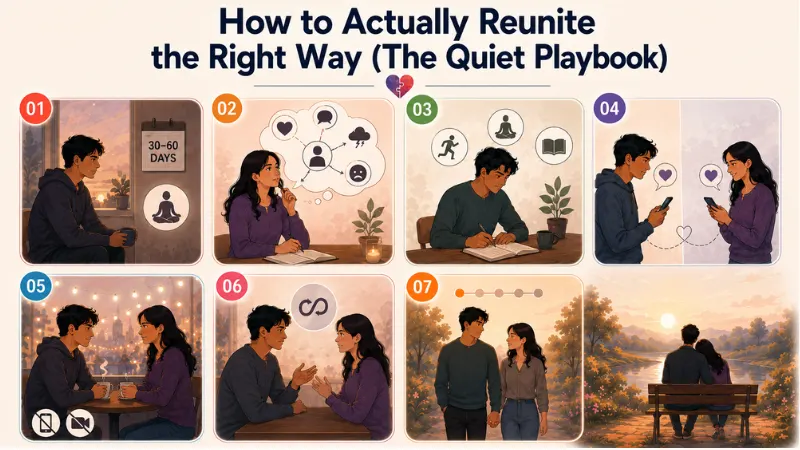
If, after reading all of this, you still feel your breakup may be one of the types that reunites — and you want to do it right — here's the playbook that real, lasting reunions follow. None of it is dramatic. All of it is slow.
- Step 1 — Sit with silence for 30–60 days. Not as a "no-contact strategy" to manipulate your ex. As an actual pause to feel everything you didn't allow yourself to feel during the relationship. The reunion will be only as deep as the silence was honest.
- Step 2 — Identify your specific contribution. Not "I wasn't enough." That's vague. Something like: "I shut down whenever you raised your voice, and that made you feel unheard." Specificity is the marker of real reflection.
- Step 3 — Do one piece of genuine inner work. Therapy. A counsellor. A journal. A long conversation with a trusted listener. Reunions without inner work are reruns of the original breakup.
- Step 4 — Reach out softly, not strategically. A simple message. No long paragraph. No "I miss you" if you don't mean it. Something honest like "I've been thinking about us. If you're open to a coffee sometime, I'd like that — no pressure."
- Step 5 — Meet in person, not on video, not on text. Reunion conversations on text fail. The nervous system needs presence.
- Step 6 — Talk about the pattern, not the people. The mistake most couples make in a reunion conversation is rehashing who said what. The lasting reunions talk about the loop — what kept going wrong, and what each person now sees differently.
- Step 7 — Move slowly afterwards. Don't immediately move back in, plan a wedding, or post on Instagram. Let the new relationship breathe for 90 days before any big decision.
This is not glamorous advice. It is what works. The dramatic, "running in the rain, please take me back" reunions you see in movies tend to fall apart by month four.
Voices From the Field: What Experts Say About Reunions
Across the relationship research field, four threads keep repeating:
"What predicts whether couples last is not the absence of conflict — it's how they repair after conflict." — John Gottman, marriage researcher, four decades of data
"The crisis of a long relationship is rarely whether to stay or to leave. It is whether to grow, and whether you can do it together." — Esther Perel, psychotherapist
"In our practice we see that Indian couples who reunite well are the ones who did two things: stopped blaming each other for the breakup, and stopped blaming themselves." — Counsellors at Indian relationship platforms
"Reconciliation is not the absence of pain. It is the presence of safety, again." — A line that quietly travels through breakup-recovery support groups online
A Quiet Word Before You Decide
If you've reached this far, you probably weren't just looking for a list. You were looking for permission — either to hope, or to let go.
Here's the truth no flowchart will ever capture: the types of breakups that get back together are the ones where, even in the silence, you both quietly become better humans. Not because the other person demanded it. Because love did.
If, after sitting with this, you find that your breakup is one of the patterns above and you sense there is still life in it — go slow. Talk to yourself first. Talk to a trusted listener. Don't message them at 1 a.m. with a wine glass in your hand. Sleep on it. Then sleep on it again. The reunions that last are the ones that aren't rushed.
And if, after sitting with this, you find that your breakup belongs in the red-flag list — that too is information. That too is a kind of love, the kind you finally give to yourself.
Either way, you are not stuck. Stories keep moving. So do people.
Leave a Reply