
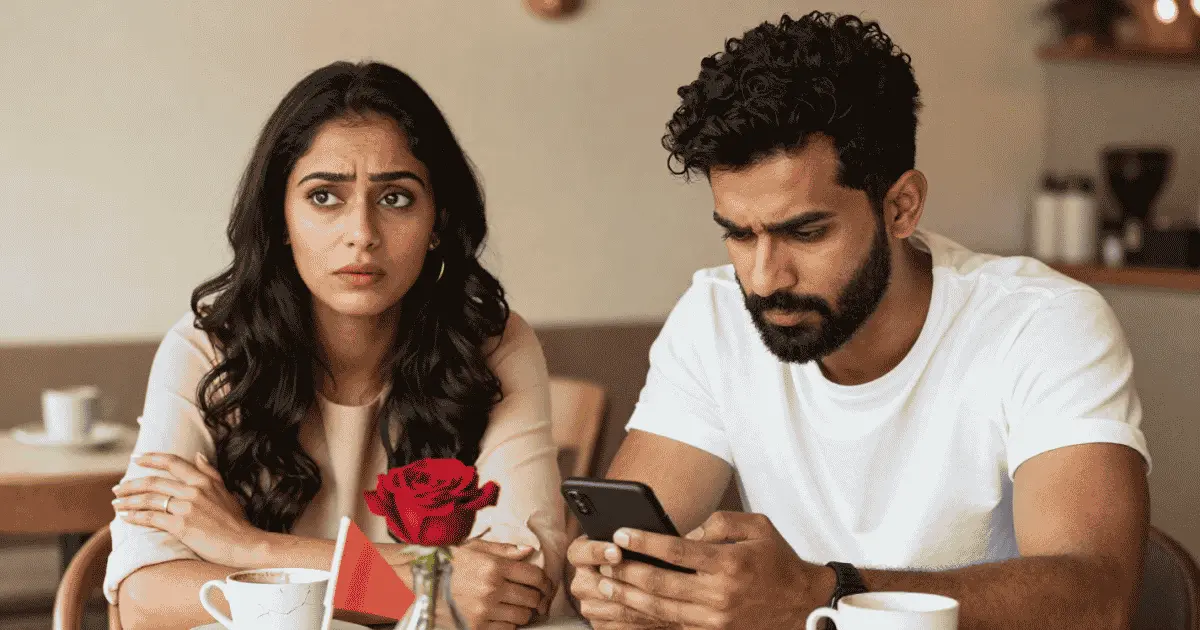
Subtle Red Flags in Relationships: What They Really Mean and Why We Keep Missing Them
The term "subtle red flag" has become so overused across Instagram captions, WhatsApp threads, and Reels comment sections that we have somehow lost sight of what it actually means. Most people walk past genuine warning signs daily — not out of ignorance, but because the real red flag meaning in a relationship is never dramatic or loud. It doesn't announce itself. Instead, it disguises itself in quiet justifications like "he's just intense," or "she's had a difficult past," or the most deceiving narrative of all — "perhaps I'm simply expecting too much." Subtle red flags in relationship don't shatter — they crack, slowly and silently, until the damage becomes impossible to ignore. Recognising them early isn't about being suspicious — it's about being honest with yourself before the whispers become walls.
This article is for every young Indian navigating love in 2025 — the college student in a new situationship, the working millennial who keeps attracting the same type, the teen who thinks what they are experiencing is just 'normal couple stuff,' and anyone who has ever googled 'am I overreacting?' at 2 AM. You are not. And this is for you.
What Do You Mean by a Red Flag in a Relationship?
Let us start from the basics. A red flag in a relationship is a warning sign — a pattern of behaviour, an attitude, or an action that signals the relationship could be unhealthy, disrespectful, or emotionally unsafe. Think of it as a 'sneak preview,' as therapists often say. If the preview looks off, the full film rarely surprises you in a good way.
The red flag meaning in a relationship is not about judging one bad day or a single mistake. It is about patterns. Patterns that, if ignored early, tend to grow into something much harder to leave later.
Red Flag, Green Flag, Yellow Flag — What Is the Difference?
- Red Flag: A consistent behaviour that signals manipulation, disrespect, control, or emotional harm.
- Green Flag: A behaviour that shows up as emotionally safe, respectful, and trustworthy.
- Yellow Flag: Something worth paying attention to. Not an instant dealbreaker, but not something to dismiss either.
Knowing the red flag and green flag meaning in a relationship gives you a language for things you have been feeling but could not name. That language is power.
Red Flags at the Beginning of a Relationship: When 'Too Good to Be True' Actually Is
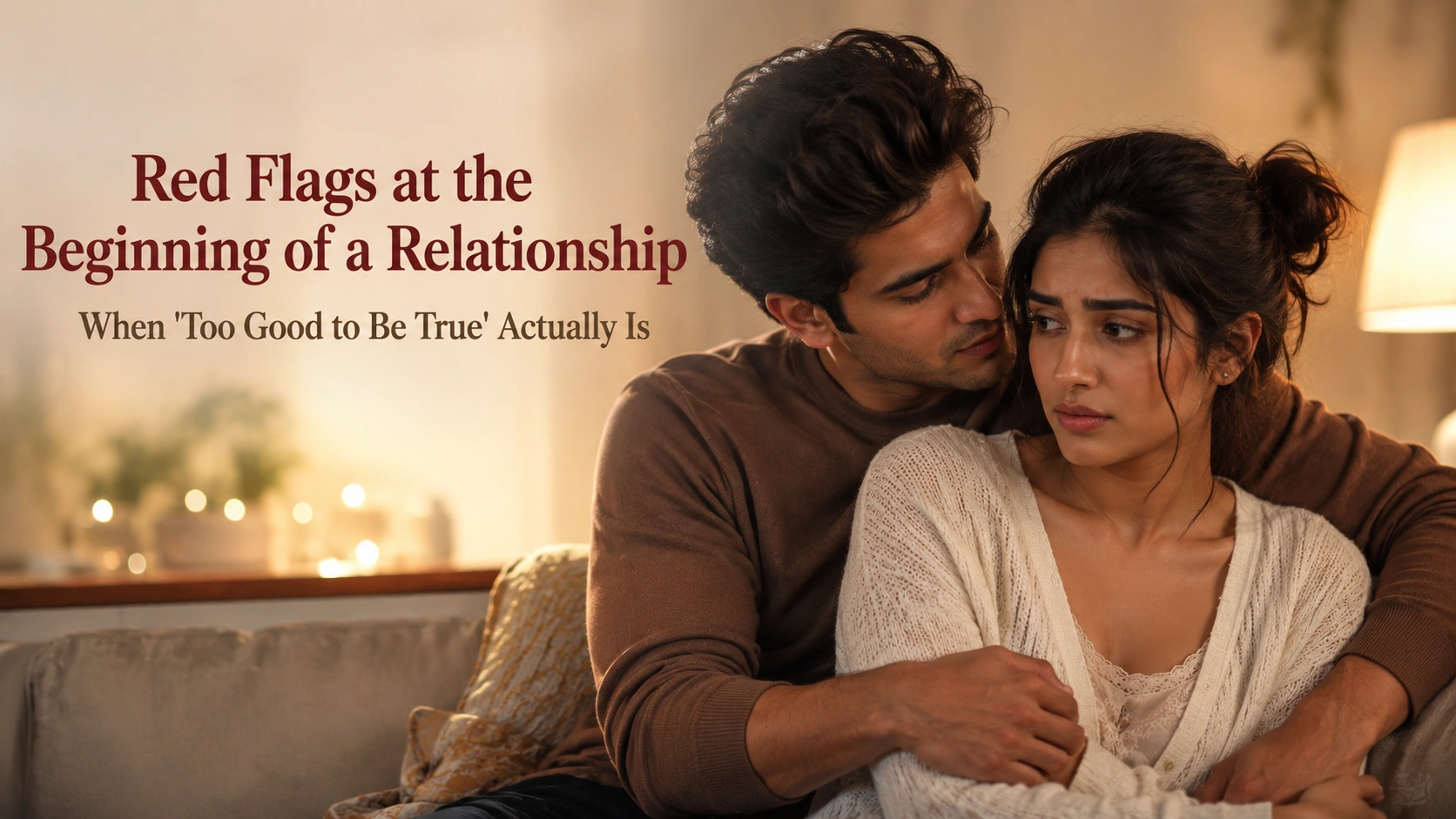
The early phase of dating is when most people are on their best behaviour. So if something feels off in the first few weeks, take that feeling seriously. Here are the most common red flags in early relationships that Indian millennials and Gen Z frequently overlook.
Love Bombing: Pyaar ki Overdose
Love bombing is one of the most misunderstood red flags at the beginning of a relationship. It looks like intense romance. It feels like a Bollywood film. But underneath, it is a manipulation tactic — often used by narcissistic personalities to hook you before you have had time to see who they really are.
Signs of love bombing in a new relationship:
- They say 'I love you' within days or a few weeks
- They flood you with gifts, constant texts, and future plans before you even know each other
- When you ask them to slow down, they become sulky, guilty-trip you, or say 'I just love hard'
- They need to know where you are at every moment — framed as care, not control
Real Red Flag Relationship Scenario: You matched with someone on a dating app. Within a week, he has already called you 'the one,' sent you a surprise delivery to your hostel, and started talking about moving in together. When you told him it felt too fast, he went cold for two days and then said, 'I thought you felt what I felt. Maybe I was wrong.' That guilt trip at the end? That is the actual red flag.
Soft Ghosting and Inconsistency: The Hot-and-Cold Game
A term Gen Z knows intimately: soft ghosting. They technically respond — a heart react, a 'seen,' a dry 'haha' — but never truly show up. This is breadcrumbing, and it is a red flag before the relationship has even formally started. It tells you exactly how they will handle your emotional needs once things get real.
If your situationship is running hot one day and ice-cold the next with no explanation, that inconsistency is not mysterious or sexy. It is a pattern of emotional unavailability that will not fix itself once you are 'official.'
Common Red Flags in Relationships: The Full Breakdown
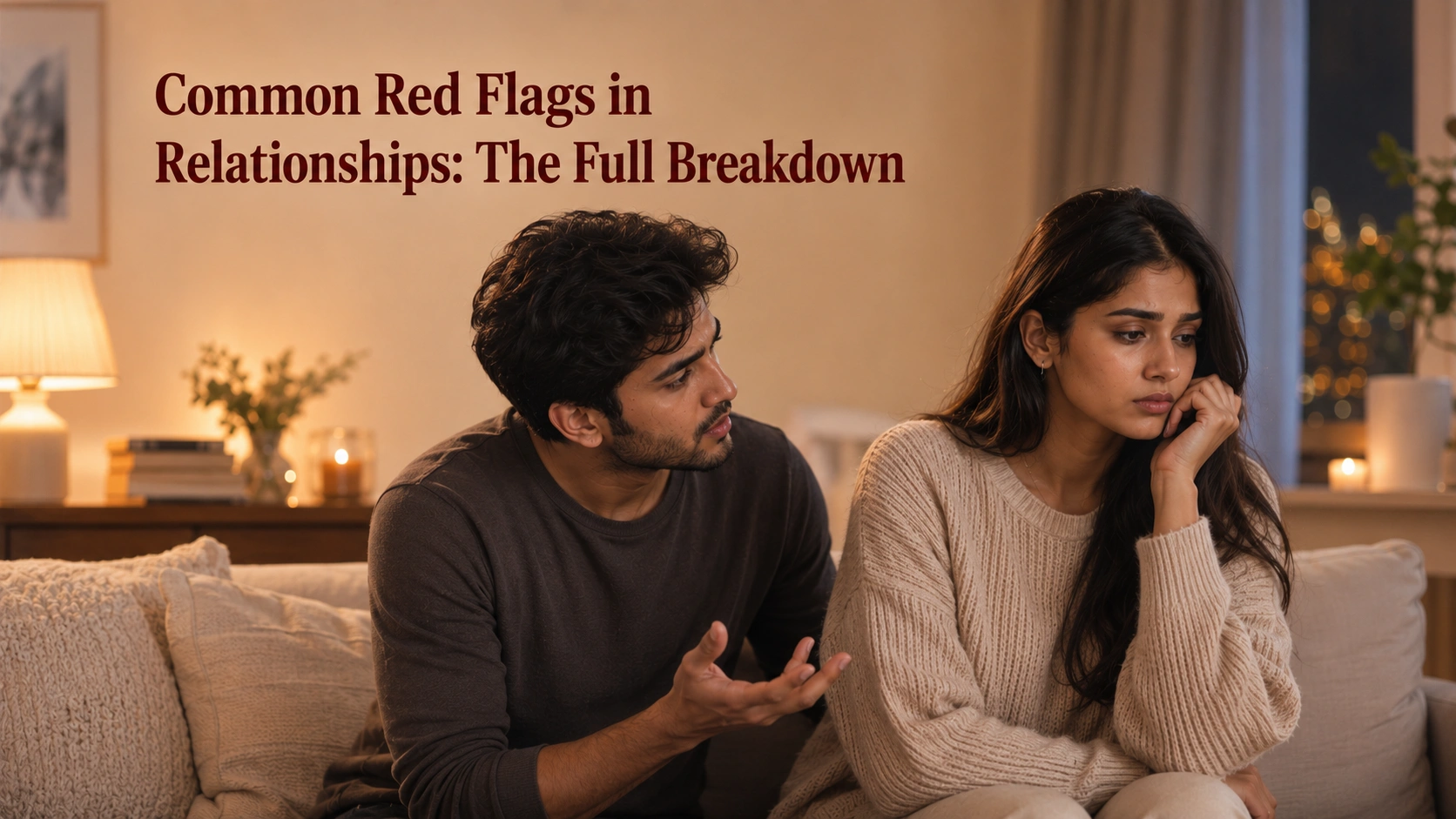
1. Gaslighting: 'Aisa Kuch Hua Hi Nahi.' Gaslighting is one of the most damaging red flags in a narcissistic relationship. The term comes from a 1938 play where a husband makes his wife believe she is imagining things — including dimming gas lamps — to drive her to question her own sanity. In modern Indian relationships, it sounds like this:
- 'Aise kuch bola hi nahi maine. Tu zyada sochti/sochta hai.' (I never said that. You think too much.)
- 'Itna sensitive kyu rehte ho? It was just a joke.'
- 'Tu sab twist kar deta/deti hai. Shayad therapy ki zaroorat hai tujhe.'
Real Red Flag Relationship Scenario: You bring up that your partner snapped at you in front of your friends at a family gathering. Instead of apologising, they say, 'You are embarrassing me by making this a big deal. Everyone noticed how dramatic you were being.' Suddenly, you are the one saying sorry — for bringing up how you felt. That reversal is gaslighting.
2. Isolation from Friends and Family: 'Sirf Main Kaafi Nahi Hoon?' This is a major red flag in a controlling relationship, and it escalates slowly. It rarely starts with a direct command. It begins with small, seemingly caring remarks:
- 'Teri woh dost teri achi nahi chahti. Mujhe toh lag raha hai she is jealous of you.'
- Ghar pe itna time kyun dete ho unko? Main hoon na.'
- 'Tu change ho jaata/jaati hai unke saath. Mujhe tu nahi chahiye woh waala version.'
Before you realise it, you have cancelled plans with your best friend three times, stopped attending family dinners, and the only person you talk to is them. That is not love. That is isolation — and it is a documented warning sign in red flags in relationships linked to domestic violence situations.
3. Reactive Abuse: Getting You to Snap on Purpose This is one of the most undertalked subtle red flags in relationships. A partner who uses reactive abuse will poke, prod, and provoke you — through sarcasm, silent treatment, passive aggression, or constant criticism — until you finally explode. Then they flip it:
'Dekho kaisa behave kar rahe ho. Tum violent ho. Main toh seedha baat kar raha/rahi tha.'
They screenshot your reaction. They tell mutual friends you are 'unstable' or 'psycho.' But nobody heard the one hour of emotional poking that came before your reaction. If you find yourself constantly 'overreacting,' ask yourself: what happened right before I reacted?
4. Controlling Behaviour Disguised as Care Red flags in a controlling relationship are often gift-wrapped in concern. Here is how the language of control masquerades as love:
What They Say vs What It Actually Means
- 'Mujhe bas teri chinta rehti hai' vs Tracking your location every hour
- 'Yeh dress suit nahi karti tujhe' vs Controlling how you present yourself to the world
- 'Mere friends ke saath kyu zyada comfortable ho?' vs Jealousy being framed as insecurity
- 'Bata de na, kyun late hua/hui?' vs Accountability you never agreed to give
Genuine care does not require control. Love that comes with conditions and surveillance is not love — it is ownership.
- Watch How They Treat Strangers: The Waiter Test
One of the most reliable red flag relationship signs is watching how your partner treats people who have no power over them — a waiter at a restaurant, an auto driver, a delivery executive, their house help. If they are charming to you but rude or dismissive to those around them, you are not seeing their best self. You are seeing who they become when they feel powerful. That version will eventually show up in how they treat you.
Red Flags Across Different Relationship Dynamics
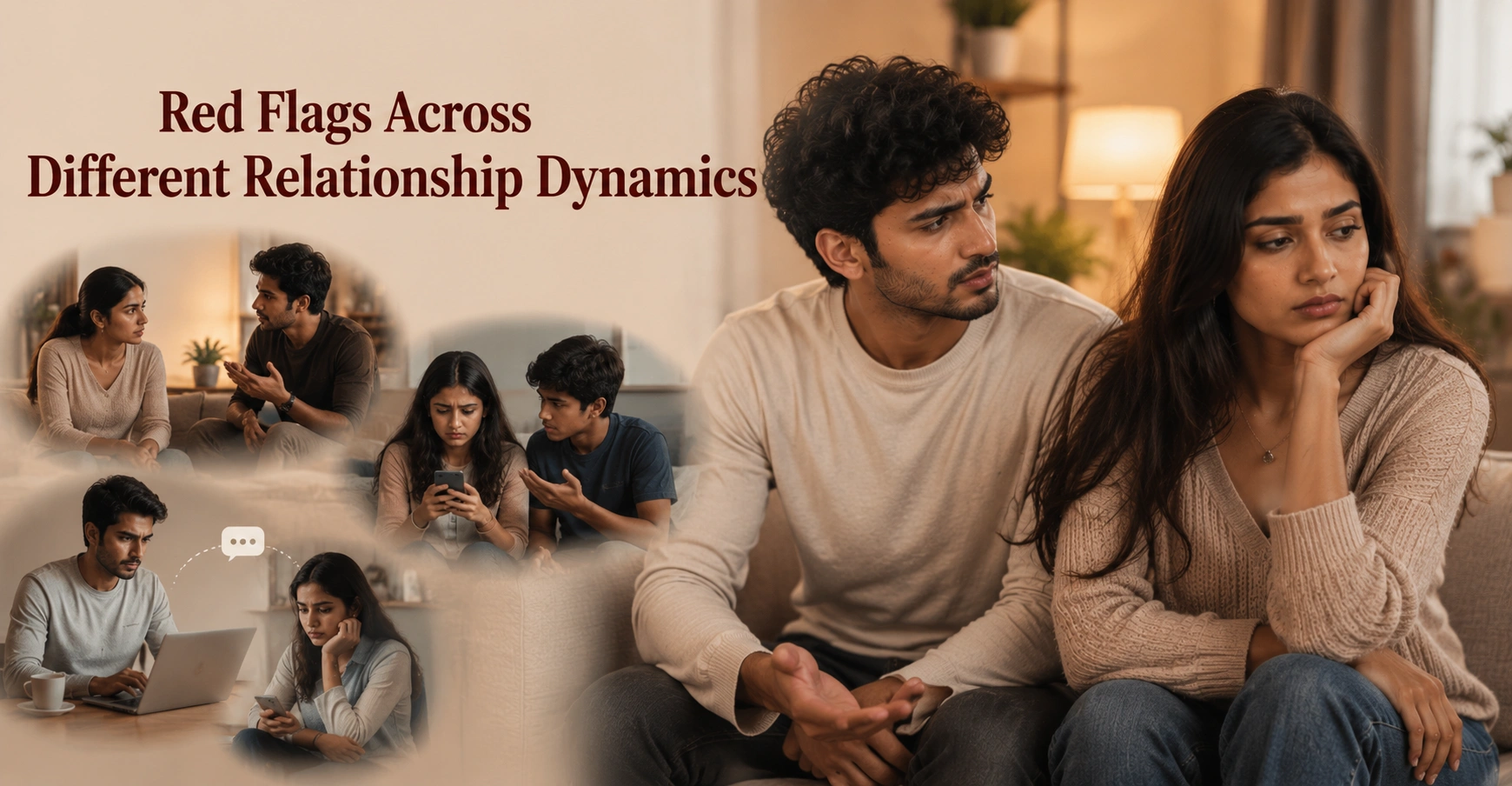
Red Flags in a New Relationship with a Woman
Women are often socialised to be nurturing and accommodating, which means their red flags sometimes get explained away. Red flags in a new relationship with a woman include:
- Extreme jealousy labelled as 'I just love you too much'
- Using emotional volatility to avoid accountability — blowing up, then expecting you to apologise for their reaction
- Keeping score of everything you have done wrong while dismissing what you have done right
- Threatening to leave at every argument as a control tactic
Red Flags in a Relationship for Men
Indian men are often told that 'real men do not feel hurt.' This conditioning makes it harder to spot red flags directed at them. Red flags in a relationship for men include:
- Being told you are 'too emotional' or 'weak' for expressing feelings
- A partner who weaponises your vulnerabilities — things you shared in private — during arguments
- Being financially shamed or made to feel inadequate for not 'providing enough'
- Emotional blackmail through threats of self-harm to prevent you from leaving
Your feelings are valid. Your discomfort matters. Your safety is not less important because of your gender
Red Flags in a Relationship for Girls and Teens
For teens navigating their first relationships, red flags in a relationship for teens often get minimised by adults with 'that is just how relationships are.' They are not. Watch for:
- A partner who wants to be your only relationship — no best friends, no family time allowed
- Pressure to share passwords, locations, or private photos
- Feeling anxious or scared before meeting them, not excited
- Being made to feel guilty for time spent with family
- Pressure around physical intimacy before you are ready, however gentle that pressure feels
If a relationship makes you feel more afraid than free — that feeling is data. Trust it.
Red Flags in a Long Distance Relationship
Long distance relationships have their own set of red flags that are easy to explain away with 'they are just busy' or 'time zones are difficult.' Red flags in a long distance relationship with a man or woman include:
- Refusing to video call — only texts, only voice notes, always an excuse
- Inconsistent availability with dramatic explanations that keep changing
- Controlling your local social life from miles away — angry about who you went out with
- Asking for money before you have met in person (a serious fraud pattern, extremely common in India)
- Always having a reason they cannot visit or meet
Dark Red Flag Meaning in a Relationship: When It Goes Beyond Unhealthy
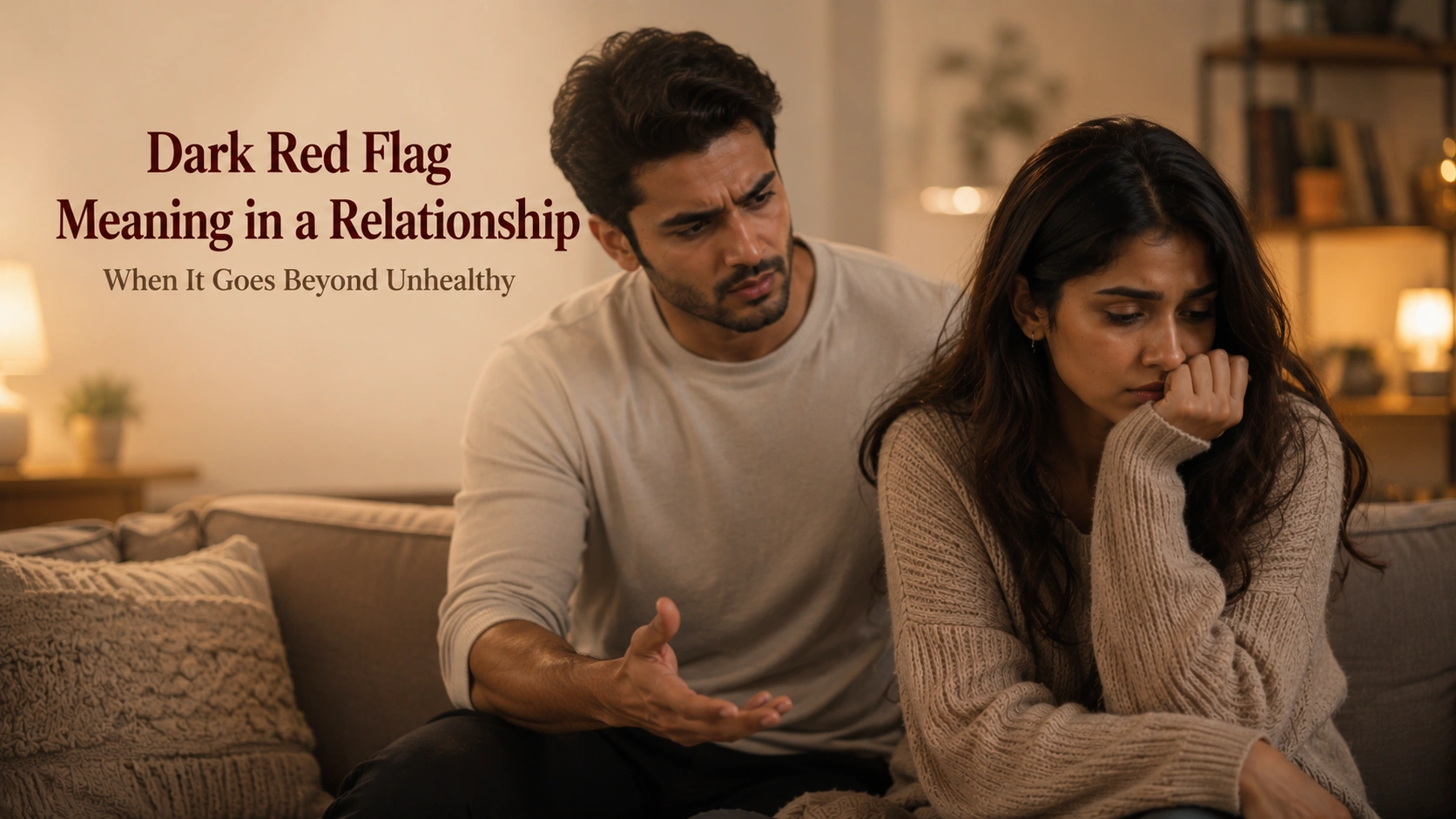
The dark red flag meaning in a relationship refers to behaviours that signal serious danger — not just emotional discomfort, but potential harm to your physical or mental safety. These include:
- Any act of physical violence — even once, even 'in the heat of the moment'
- Threats — to hurt you, themselves, your family, or your reputation
- Installing tracking apps or showing up unannounced to monitor you
- Sexual coercion — pressure, guilt, or manipulation around intimacy
- Financial abuse — controlling access to your money or your job
Red flags in relationships and domestic violence are deeply connected. Research and survivor accounts consistently show that the early signs were present — people simply did not have the language to name them. This article is part of giving you that language.
Your Red Flag Relationship Checklist
Answer these honestly. There are no right or wrong answers — only honest ones.
- Do I feel free to spend time with friends and family without conflict or guilt?
- Can I disagree with my partner without fear of their reaction?
- Do I feel emotionally safe to say how I feel?
- Does my partner respect 'no' — in any context?
- After spending time with them, do I feel lifted or drained?
- Has my partner ever made me question my own memory or feelings?
- Do I feel like I am walking on eggshells around their moods?
- Has my social circle become smaller since this relationship began?
If you checked more than two or three of these — please speak to someone you trust. A friend, a counsellor, a parent, a helpline.
Conclusion: You Deserve a Relationship That Feels Like Safety, Not Survival
Here is what our team wants to leave you with: understanding the red flag meaning in a relationship is not about being paranoid or cynical about love. It is about being informed. It is about respecting yourself enough to notice when something does not feel right — even when you cannot fully explain it yet, even when everyone else says they seem like a 'good person,' even when leaving feels scarier than staying.
Red flags rarely announce themselves. They come disguised as intensity, passion, or devotion. They come with an explanation that sounds reasonable in isolation. They come with just enough good moments to make you doubt the bad ones. That is by design.
The subtle red flags covered in this article — love bombing, gaslighting, reactive abuse, isolation, control dressed as care — are not rare or dramatic. They are happening in millions of relationships right now across India, in DMs and college campuses and arranged marriage conversations and long-distance phone calls.
Knowing the signs does not make you guarded. It makes you grounded. And a relationship built on genuine respect, consistent behaviour, and real emotional safety is possible — but it starts with being honest about what is happening in front of you right now. You are not too much. You are not overreacting. You are someone who deserves to be loved well.
Leave a Reply