

How Self Love Transformed My Happiness and my Relations— and How It can do the Same for You
There was a time I kept wondering why my relationships always felt exhausting. Why I always ended up feeling invisible in conversations, saying yes when my heart screamed no, and shrinking myself just so others could feel comfortable. I thought the problem was outside — the wrong people, the wrong timing, the wrong city. It took one very honest breakdown at 2 AM to finally look in the mirror and ask the real question: What is my relationship with myself , am I the person who do self love ?
That question changed everything.
Self-love is not a luxury. It is not a Sunday face mask or an Instagram aesthetic. For millions of Indians — from the pressure-packed middle-class households of Jaipur and Pune to the overworked professionals in Bengaluru and Mumbai — self-love is actually the missing foundation beneath every relationship, every career decision, and every attempt at happiness. And in 2026, as people actively search for terms like "how to stop seeking validation", "how to love myself after a toxic relationship", and "why do I feel empty even when life is fine", it is clear that this conversation is no longer optional.
Let's go deep into it — not surface-level advice, but the kind of honest, actionable truth that actually reshapes your inner world.
Why Self-Love Is the Starting Point of Genuine Happiness

Happiness is not a destination that arrives after you land the job, fix the relationship, or lose the weight. Neuroscience tells us that our brain operates on familiar emotional patterns — what we repeatedly think becomes wired into our neural pathways. If your internal narrative is built on self-criticism, comparison, and scarcity ("I am not enough," "nobody values me," "why does this always happen to me"), your brain will filter reality through that lens and find evidence to confirm it every single day.
Self-love is, in its most practical sense, the act of reprogramming that internal narrative. It is choosing — daily, deliberately — to treat yourself with the same warmth you would give a dear friend. When you start doing that, dopamine is not triggered by external approval anymore. Your baseline emotional state begins to rise. You feel calmer, clearer, and more capable of genuine joy.
This is how self-love increases happiness — not by adding more things to your life, but by shifting the frequency from which you experience life.
How to Reprogram Subconscious Self-Talk — The Step Nobody Talks About
Most people think affirmations are about repeating "I am confident" until they believe it. That approach alone rarely works — especially when your subconscious has decades of contradicting evidence stacked against it.
Reprogramming subconscious self-talk requires something more precise: catching the moment the negative thought enters, naming it, and replacing it with a truthful alternative.
For example, instead of the thought "I always mess things up," pause right there. Name it: "That is a shameful story, not a fact." Then redirect: "I have handled hard things before and I can learn from this." This is not toxic positivity. This is cognitive restructuring — the same technique therapists use in Cognitive Behavioural Therapy (CBT).
Practical micro-habit: Keep your phone's notes app open and every evening write down one moment where your inner critic spoke. Write what it said, then write what a compassionate coach would have said instead. Do this for 21 days. Your brain's default script will begin to shift. This is not magic — it is neuroplasticity in action.
Self-Love and Self-Care for Your Relations — The Truth Most People Miss

Here is what the internet often gets wrong about self-love and relationships: it is not about loving yourself instead of others. It is about loving yourself so well that you show up as a whole person in your relationships — not a half-empty one desperately looking to be filled by someone else.
Think of Priya , a 29-year-old marketing professional from Delhi. She was in a relationship where she constantly adjusted her opinions, her plans, and her personality to keep her partner happy. She called it a compromise. What it actually was — was self-abandonment. The moment she began a self-love practice (journaling, therapy, and setting one boundary per week), the relationship dynamic shifted. Either her partner adjusted to respect her authentic self, or she was finally clear enough to walk away. Either outcome, she was protected.
Self-love and self-care in relationships means:
- Communicating your needs without the guilt of being "too much"
- Choosing people who celebrate your growth, not just your availability
- Recognising when you are giving from fullness versus giving from fear
- Showing up emotionally present because you have processed your own emotional backlog
Dopamine Detox for Emotional Clarity — Why Your Nervous System Needs a Reset
Indians in 2026 are constantly stimulated — reels, WhatsApp forwards, opinion battles on X (Twitter), back-to-back deadlines. Beneath all this noise, the nervous system is running on high alert, and emotional clarity becomes nearly impossible. You cannot hear your own truth when every silence is immediately filled with a notification.
A dopamine detox — even a partial one — is one of the most powerful acts of self-love in this era. It does not mean sitting in a cave for 30 days. It means: A dopamine detox — even a partial one — is one of the most powerful acts of self-love in this era. It does not mean sitting in a cave for 30 days. It means:
- One hour every morning without your phone and any other gadgets
- No social media for 24 hours every Sunday, give that time to yourself and your loved ones
- Replacing one scroll session with 10 minutes of sitting in silence or a slow walk
- Eating one meal without a screen try this at least for 21 days
When you reduce the noise, you reconnect with your actual emotional state. You start to feel what you have been numbing. That feeling — however uncomfortable — is information. It tells you what you truly want, what is draining you, and what needs to change. Emotional clarity is the soil in which genuine self-love grows.
Setting Boundaries Without Guilt — The Most Radical Act of Self-Respect

In Indian families and workplaces, the very word "boundary" can feel foreign or even selfish. We are raised in a culture of collectivism — and there is beauty in that — but when collectivism turns into chronic self-sacrifice, it becomes a slow poison.
A boundary is not a wall. It is a statement of your values.
When you tell your mother, "Mummy, I love you and I cannot attend every family function — I need rest on weekends," that is a boundary. When you tell your manager, "I will not be checking work messages after 9 PM," that is a boundary. The guilt you feel after setting a boundary is not a signal that you did something wrong. It is simply the discomfort of doing something new in a system that was built around your old patterns.
The way to set boundaries without guilt: state them calmly, without over-explaining. You do not owe a five-paragraph justification for your limits. The more you explain, the more negotiation room you create. Practice this script: "I am not available for that. What I can do is [alternative]." Repeat it until it becomes natural. The guilt will shrink with repetition.
Self-Love Journey Milestones in 2026 — What Real Progress Looks Like
One of the most common frustrations people share in therapy and coaching spaces is: "I have been working on myself for months — why don't I feel different?" The answer is usually that they are measuring their growth incorrectly. They are waiting for a lightning-bolt transformation when self-love actually reveals itself in quiet milestones.
Here are the milestones worth tracking on your self-love journey:
- You stop explaining yourself to people who were never going to understand you anyway
- You rest without guilt — a full Sunday nap is no longer loaded with productivity shame
- You walk away from conversations that diminish you, without a three-day guilt hangover
- You celebrate small wins internally, without waiting for someone else to notice
- You recognise red flags early in relationships instead of convincing yourself they will change
- You choose discomfort in service of growth over comfort in service of stagnation
These are not dramatic changes. But they are the ones that compound into a fundamentally different life.
Inner Child Healing for Adult Happiness — The Work That Changes Everything
Every adult pattern of people-pleasing, fear of rejection, emotional withdrawal, or compulsive overachieving has a root — and that root almost always leads back to childhood. This is not about blaming parents. Most Indian parents gave what they knew how to give. But certain emotional needs — the need to be seen, to be celebrated for simply existing, to have emotions validated rather than suppressed — often went unmet.
Inner child work is the process of going back to those unmet needs, acknowledging them as real, and providing the emotional reparenting your adult self now has the capacity to offer.
A simple starting exercise: Find a childhood photo of yourself. Sit with it. Look at that version of you — before the responsibilities, the comparisons, the shame. Write a letter to that child. Tell them what they needed to hear. "You are enough. You do not have to earn love. Your feelings make sense." This exercise sounds simple. The emotional release it creates is anything but. Many people discover, within this practice, the exact origin point of their heaviest adult wounds.
Emotional Regulation — The Skill That Makes All Other Self-Love Practices Work
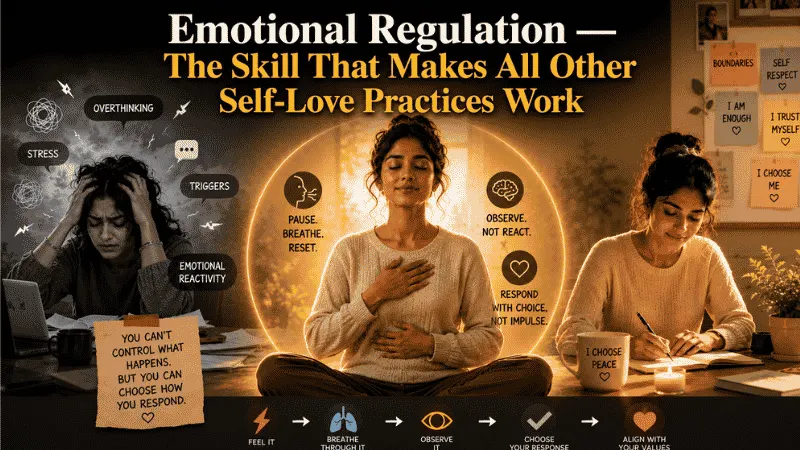
You can journal every day, set boundaries with confidence, and practice affirmations religiously — but if you cannot regulate your emotional responses in real-time, relationships will still feel chaotic. Emotional regulation is the bridge between intention and behaviour.
In high-stress moments — an argument with a partner, a dismissive comment from a relative, a performance review that stings — the nervous system goes into fight-flight-freeze. From that state, you are not responding from your values. You are reacting from your wounds.
The practice: when emotional intensity rises, breathe out longer than you breathe in. A 4-count inhale and a 6-count exhale activates the parasympathetic nervous system within 90 seconds. From that calmer state, you can ask: "What is actually happening here? What do I need? What would my best self say or do?" Emotional regulation is not about suppression. It is about creating a deliberate pause between the stimulus and your response. That pause is where your growth lives.
Self-Love Affirmations, Quotes, and a Self-Care Routine That Actually Works

Affirmations are only powerful when they are specific enough to bypass cynicism. Generic statements like "I love myself" often feel hollow at first. Start with bridge affirmations — statements that feel almost true, even on hard days:
- "I am learning to trust myself more every day."
- "My needs are valid and worth expressing."
- "I am allowed to take up space."
- "I choose people who choose me without hesitation."
- "I release the need to earn my own worthiness."
For quotes that carry weight — remember this one by Brené Brown: the degree to which we know our own worthiness is the degree to which we can love others deeply without losing ourselves..
A realistic self-care routine for Indians who are time-strapped:
- Morning (10 minutes): Phone-free. One glass of water. Two minutes of deep breathing. One sentence journaling: "Today I choose to..."
- Afternoon (5 minutes): Step outside. Notice three things around you. Reconnect with your body.Afternoon (5 minutes): Step outside. Notice three things around you. Reconnect with your body.
- Evening (15 minutes): No news, no reels. Read, stretch, or simply sit. Let your nervous system land.
- Weekly: One activity purely for joy — not productivity, not networking — just joy.
Conclusion: The Relationship You Have With Yourself Sets the Template for Every Other One
Every relationship in your life — romantic, familial, professional, social — is a mirror of the relationship you carry inside yourself. When you are at war with yourself, you attract conflict. When you are emotionally hollow, you attract people who take without giving. But when you are genuinely at peace with who you are — when you have done the inner work, repaired the self-talk, set the boundaries, and begun to heal the wounds — something shifts in the field around you. People who match your energy begin to appear. Draining relationships begin to feel incompatible. Genuine happiness stops being something you seek outside and becomes something you generate from within.
The self-love journey is not linear. There will be days you regress, doubt, and feel like none of this is working. Go back anyway. Return to the practices. Return to yourself. Because the most important relationship of your entire life is not the one you are chasing — it is the one you have been carrying with you all along. Start there. Everything else will follow.
Leave a Reply